SafeCare BC Logo
SafeCare BC Logo
Programs & Services

Programs and Services

View All
We are dedicated to providing comprehensive occupational health and safety (OHS) consulting services tailored to your needs.
View Service
Psychological health and safety, often called workplace mental health, encompasses principles and practices to foster a supportive, respectful, and psychologically safe work environment.
View Service
The Provincial Violence Prevention Curriculum is recognized as best-practice in violence prevention training for health care workers.
View Service
Guidelines & Regulations

Guidelines and Regulations

View All
WorkSafeBC has paused its consultations on proposed changes to the Occupational Health and Safety Regulation addressing psychological health and safety, harassment, and violence. The pause is due to the provincial election and is procedural; it does not indicate that a decision has been made about the proposed changes.  The proposals would introduce significant new and […]
View News Story
WorkSafeBC has paused its consultations on proposed changes to the Occupational Health and Safety Regulation addressing psychological health and safety, harassment, and violence. The pause is due to the provincial election and is procedural; it does not indicate that a decision has been made about the proposed changes.
View News Story
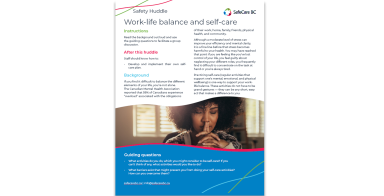
Mastering work-life balance is essential for healthcare safety. Discover practical strategies to prevent burnout, manage busy shifts, and improve care for those you support.
Supporting work-life balance | Safety huddle

Mastering work-life balance is essential for healthcare safety. Discover practical strategies to prevent burnout, manage busy shifts, and improve care for those you support.

After this huddle, staff should be able to:

  • Define work-life balance and its significance for individual health and resident / client care.
  • Identify workplace factors that can disrupt balance, such as heavy workloads or lack of breaks.
  • Apply practical strategies to support team members in achieving work-life harmony during busy shifts.

How to run the safety huddle

As the huddle leader, do the following:

  • Before the huddle, review the huddle content and huddle leader notes.
  • Have resources ready, such as policies, employee assistance programs, or SafeCare BC resources.
  • Choose a scenario that fits your workplace and read it aloud.
  • Use the guiding questions to lead the discussion.
  • Use huddle leader notes as support while leading the discussion.
  • Keep the discussion short to about 5-10 minutes.

Definitions

Work-life balance means managing the demands of your job alongside your personal and family life. Balance supports your well-being by reducing stress and preventing work issues from affecting your home life. Balance can also improve your job satisfaction, prevent burnout and contribute to your overall health. It is about recognizing that we have many essential roles, such as being employees, parents, caregivers to family (including aging parents), and partners.

Scenario for long-term care

Kwame, a care aide, is working an evening shift at his care home. The unit is unusually busy because two colleagues called in sick, leaving the team short-staffed. Kwame is constantly rushing between rooms, answering call bells, and assisting with dinner. He planned to take his dinner break at 6:00 p.m. but it is now 7:30 p.m., and he still has several residents to help prepare for bed. Exhausted, Kwame decides to skip his break entirely. He eats a granola bar at the nursing station while finishing his charting. He notices he is becoming more impatient with residents, and his back is starting to ache. He tells himself he will eat properly at home, but he feels completely drained.

Guiding questions for long-term care

  • What signs suggest that Kwame’s work-life balance is being disrupted during this shift?
  • What could Kwame or his teammates do in the moment to ensure he gets at least a short break?
  • How does skipping breaks affect the quality of care provided to residents?

Facilitation tip: Listen for staff who feel that skipping breaks is “just part of the job.” Gently redirect them to think about how being overtired can lead to errors or injuries. Remind the team that balance isn’t only about work and home but also about balancing their well-being against the demands of work. Encourage them to brainstorm how they can “tag-team” to cover each other’s breaks.

Scenario for home care

Lena is a home health care worker with seven client visits scheduled across the city. Her first client, Mrs. Chen, had a fall during the night and needed extra reassurance, which put Lena 20 minutes behind schedule. This delay creates a domino effect. Lena skips her coffee break and gobbles her lunch in her car while stuck in traffic. By her fifth client, she realizes she is making small errors, like forgetting to initial a medication chart. She feels her heart racing and her patience wearing thin as she hurries to her last client’s home. Lena knows her care isn’t up to her usual standards because she is too focused on the clock.

Guiding questions for home care

  • How does the stress of trying to “catch up” affect Lena’s well-being and her connection with her clients?
  • What resources or communication tools could Lena use when she realizes her schedule is becoming unmanageable?
  • What can supervisors do in the moment when a worker is running behind? What can be changed in the schedule or expectations so that Lena doesn’t feel forced to rush?

Facilitation tip: If the conversation turns into a complaint about scheduling, ask: “What is one specific thing we could do today to improve how we communicate when someone is running behind?”

Huddle leader notes

  1. Create a safe space:
    • Listen, respect all views, and be mindful of others’ challenges.
    • Guide the discussion to focus on what participants can control.
    • Move the conversation from complaints to solutions, strengths, and helpful actions.
    • Invite anyone with specific concerns to talk with you after the huddle.
  2. Key discussion points: Use the objectives and key discussion points below to guide the huddle if needed.
    • Encourage breaks: Remind staff that taking entitled breaks is essential for health and a core part of creating balance. It is crucial or job satisfaction, preventing burnout, and supporting better care of residents or clients.
    • Work-life balance: Support staff in talking to supervisors when they struggle to balance their roles at work and home.
    • Organizational support: A healthy organization fosters a workplace where workers still have energy left for their personal lives after their shift ends.

Downloads
Supporting work-life balance | Safety huddle
Mastering work-life balance is essential for healthcare safety. Discover practical strategies to prevent burnout, manage busy shifts, and improve care for those you support.
Download
918.1KB
Supporting work-life balance

Additional Resources

A short pause holds powerful potential, especially when it helps you become more present, focused, and productive.
View News Story
Feeling worn out is a common refrain in the care sector, where long hours and emotional stress are chronic. But what if the solution isn't just about more resources, but clearer boundaries? For leaders in long-term care and home health, establishing a culture of respect and balance is no longer a soft skill—it's a critical strategy for preventing burnout, reducing errors, and ensuring the safety and well-being of staff and those they care for.
View News Story
Discover how to activate your parasympathetic nervous system to build inner resilience, helping you stay calm and centred amidst high-stress work and life demands.
View Webinar
Achieve a work-life balance by developing and implement your own self-care plan plan.
Files Attached
View Safety huddle
Burnout happens when stress builds up over time, leaving you feeling drained, unmotivated and exhausted. Learn how to recognize the signs, understand the causes, and take practical steps to prevent burnout for yourself and your team.
View Safety Topic

More Safety huddles

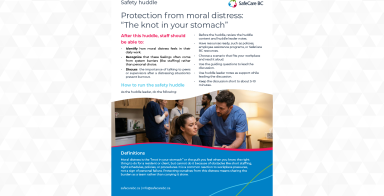
This huddle will help you lead a discussion on moral distress and the importance of talking to peers or supervisors after a distressing situation to prevent burnout.
Files Attached
View Safety huddle
This safety huddle can be used to lead a discussion on how assuming positive intent can reduce workplace tension.
Files Attached
View Safety huddle
Mastering work-life balance is essential for healthcare safety. Discover practical strategies to prevent burnout, manage busy shifts, and improve care for those you support.
Files Attached
View Safety huddle
Learn when workers can stop unsafe tasks, report concerns, and follow the right process to stay safe.
Files Attached
View Safety huddle
Equip your team with the skills to spot workplace hazards before they cause an injury. This safety huddle guides staff through conducting an environmental scan, a key part of any point of care risk assessment. Discover how to build a proactive safety culture and protect your healthcare team.
Files Attached
View Safety huddle
In this huddle, we’ll review safe and effective cleaning and disinfecting practices in the workplace. Staff will learn how to follow workplace policies, clean and disinfect shared equipment and high-touch areas, and select the right personal protective equipment (PPE) for different cleaning tasks. We’ll also cover where to find important information such as safety data sheets and product labels, which explain safe handling and spill response procedures. Use the guiding questions to spark discussion about common high-risk areas, frequently shared items, and strategies for reducing the spread of infectious diseases.
Files Attached
View Safety huddle
Working with clients or residents and their families is not always easy. You may not be able to control how others act, but you can control how you respond.
Files Attached
View Safety huddle
When a critical incident impacts your team, it's vital to have a safe space to talk and heal. Our critical incident debriefing tools provide leaders and frontline staff in BC's long-term care and home support sectors with a structured way to discuss what happened, ensuring everyone feels supported with dignity and respect. Discover how to create a culture of psychological safety, identify available resources, and learn to navigate these challenging conversations to promote recovery and well-being.
Files Attached
View Safety huddle
Browse by Resource Type

Resources Related to , ,

This fall, the Hearts and Hands conference for health care assistants will bring frontline care workers together for a day of learning, connection and celebration. In Langley, Jody Braam will lead a breakout session exploring what it means to truly listen in dementia care, even when words are no longer there.   Jody Braam was […]
View News Story
October 8 @ 11:00am to 12:00pm
This webinar explores what organizations can realistically influence and where larger systemic change is needed.
View Webinar
This handout contains resources related to the Compassion begins with curiosity webinar.
Files Attached
View Bundle
There’s a strange thing that happens when you become very good at holding everything together. People stop asking if you are okay.  You show up, do the work, care for the people who need you and become the person others can rely on. Somewhere along the way, carrying too much can start to look a […]
View News Story
SafeCare BC Logo
©2026 SafeCare BC | All rights reserved.
To empower workplaces that provide care to create a culture of safety through evidence-based education, advocacy for safer workplaces, leadership, and collaboration
cross