SafeCare BC Logo
SafeCare BC Logo
Programs & Services

Programs and Services

View All
We are dedicated to providing comprehensive occupational health and safety (OHS) consulting services tailored to your needs.
View Service

Psychological health and safety, often called workplace mental health, encompasses principles and practices to foster a supportive, respectful, and psychologically safe work environment.
View Service

The Provincial Violence Prevention Curriculum is recognized as best-practice in violence prevention training for health care workers.
View Service
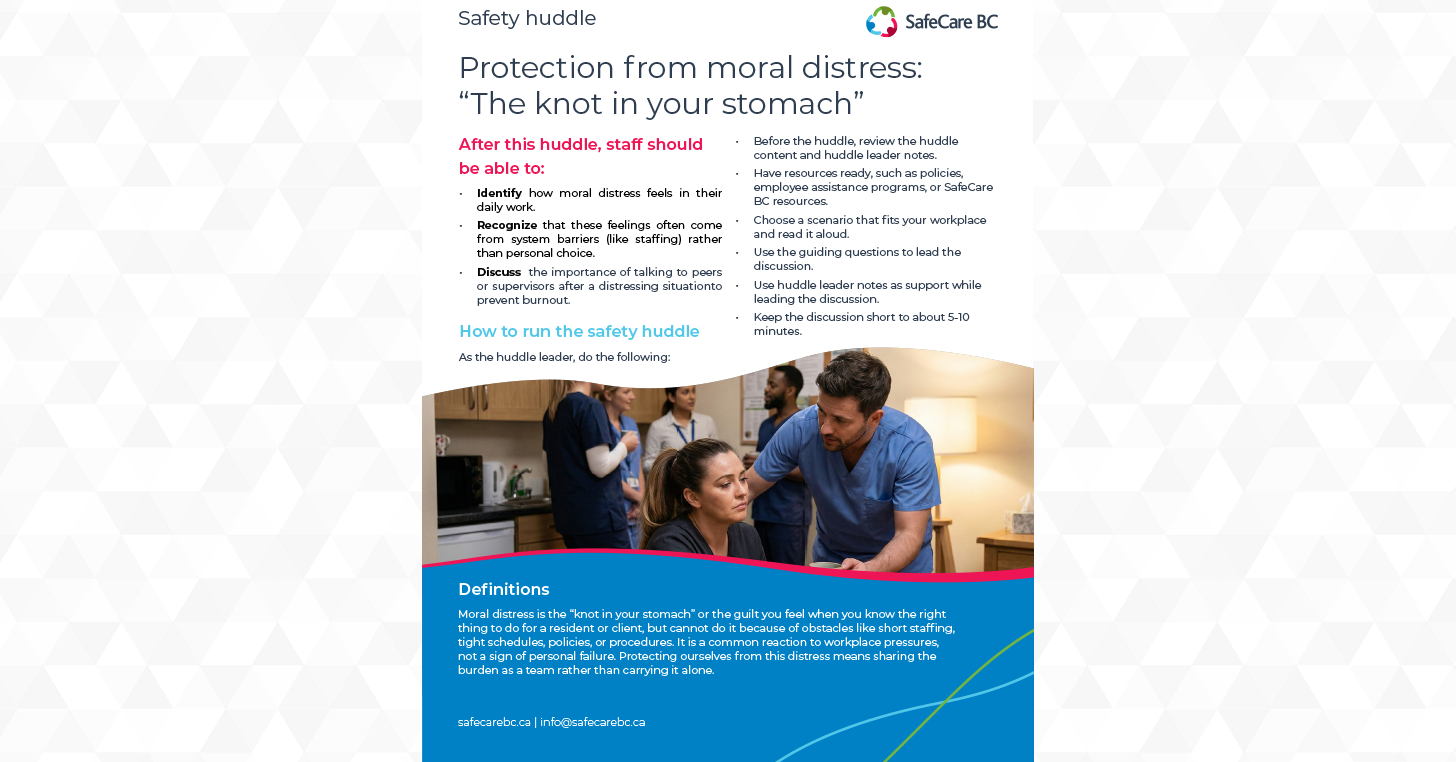
Safety huddle

Protection from moral distress: "The knot in your stomach"

This huddle will help you lead a discussion on moral distress and the importance of talking to peers or supervisors after a distressing situation to prevent burnout.
Protection from moral distress: "The knot in your stomach" - Safety huddle

After this huddle, staff should be able to:

  • Identify how moral distress feels in their daily work. 
  • Recognize that these feelings often come from system barriers (like staffing) rather than personal choice. 
  • Discuss the importance of talking to peers or supervisors after a distressing situation to prevent burnout.

How to run the safety huddle

As the huddle leader, do the following:

  • Before the huddle, review the huddle content and huddle leader notes.
  • Have resources ready, such as policies, employee assistance programs, or SafeCare BC resources.
  • Choose a scenario that fits your workplace and read it aloud.
  • Use the guiding questions to lead the discussion.
  • Use huddle leader notes as support while leading the discussion.
  • Keep the discussion short to about 5-10 minutes.

Definition

Moral distress is the "knot in your stomach" or the guilt you feel when you know the right thing to do for a resident or client, but cannot do it because of obstacles like short staffing, tight schedules, policies, or procedures. It is a common reaction to workplace pressures, not a sign of personal failure. Protecting ourselves from this distress means sharing the burden as a team rather than carrying it alone. 

Scenario for long-term care

Maria is a care aide at a busy care home. Today, her unit is short-staffed. While she is rushing to get residents ready for breakfast, Mrs. Kowalski—who is grieving—grabs her hand and asks, "Can you just sit with me? I’m so lonely." Maria knows the right thing to do is stay, but she has five other residents waiting for care. Heartbroken, Maria gives a quick pat on the shoulder and rushes out. She spends the rest of her shift feeling like a "bad caregiver" and wondering if she should have stayed despite the pressure. 


Guiding questions for long-term care 

  • In Maria's position, what could she have said or done that might have helped both her and Mrs. Kowalski in that moment?  
  • If you saw a colleague looking upset after a similar interaction, what would you say to help them realize it wasn't their fault?  
  • How can we support each other during a chaotic shift to remind ourselves we are doing our best with the resources we have? 

Facilitation tip: Watch for staff who try to act "tough" or dismiss their feelings. Encourage them to admit when a shift is emotionally hard, as "stuffing down" these feelings can lead to burnout. 

Scenario for home care  

David is a home health worker with a packed schedule. When he arrives at Mr. Singh's home, he finds that Mr. Singh has soiled himself. Cleaning and changing him properly will take far longer than the 30 minutes David has, and his next client is waiting on time-sensitive medication. David rushes through the cleanup. Mr. Singh goes quiet and looks embarrassed. Driving away, David feels angry — like he let someone down because the schedule left him no real choice. 

Guiding questions for home care 

  • How did the tight schedule force David to make a "least-worst" choice?  
  • When you are caught between a client's needs and a scheduling policy, who is the best person to talk to?  
  • What support do you need from leadership to ensure you don't carry this anger home with you? 

Facilitation tip: Listen for specific barriers like "communication" or "scheduling". If the team identifies a recurring stressor, commit to looking into that workflow after the huddle. 

Huddle leader notes 

  1. Create a safe space: 
    • Listen, respect all views, and be mindful of others’ challenges. 
    • Guide the discussion to focus on what participants can control. Move the conversation from complaints to solutions, strengths, and helpful actions. Invite anyone with specific concerns to talk with you after the huddle. 
  1. Key discussion points: Use the objectives and key discussion points below to guide the huddle if needed. 
    • It’s not just you: Feeling distressed shows you are a caring professional. 
    • Don't suffer in silence: Talking to a supportive team is the best way to protect your mental health. 
    • Leaders have your back: Management is there to help guide you when resources are tight. 
Downloads
Protection from moral distress: "The knot in your stomach" - Safety huddle
Protection from moral distress: "The knot in your stomach"

Additional Resources

This safety huddle help staff recognize what feelings they might experience during a wildfire crisis event.
Files Attached
View Safety huddle
Psychological safety is a basic human need that shapes how people think, communicate, and contribute at work. Learn how creating safer, more supportive workplaces can strengthen trust, reduce burnout, and help teams thrive.
View Safety Topic

More Safety huddles

This huddle will help you lead a discussion on moral distress and the importance of talking to peers or supervisors after a distressing situation to prevent burnout.
Files Attached
View Safety huddle
This safety huddle can be used to lead a discussion on how assuming positive intent can reduce workplace tension.
Files Attached
View Safety huddle
Mastering work-life balance is essential for healthcare safety. Discover practical strategies to prevent burnout, manage busy shifts, and improve care for those you support.
Files Attached
View Safety huddle
Learn when workers can stop unsafe tasks, report concerns, and follow the right process to stay safe.
Files Attached
View Safety huddle
Equip your team with the skills to spot workplace hazards before they cause an injury. This safety huddle guides staff through conducting an environmental scan, a key part of any point of care risk assessment. Discover how to build a proactive safety culture and protect your healthcare team.
Files Attached
View Safety huddle
In this huddle, we’ll review safe and effective cleaning and disinfecting practices in the workplace. Staff will learn how to follow workplace policies, clean and disinfect shared equipment and high-touch areas, and select the right personal protective equipment (PPE) for different cleaning tasks. We’ll also cover where to find important information such as safety data sheets and product labels, which explain safe handling and spill response procedures. Use the guiding questions to spark discussion about common high-risk areas, frequently shared items, and strategies for reducing the spread of infectious diseases.
Files Attached
View Safety huddle
Working with clients or residents and their families is not always easy. You may not be able to control how others act, but you can control how you respond.
Files Attached
View Safety huddle
When a critical incident impacts your team, it's vital to have a safe space to talk and heal. Our critical incident debriefing tools provide leaders and frontline staff in BC's long-term care and home support sectors with a structured way to discuss what happened, ensuring everyone feels supported with dignity and respect. Discover how to create a culture of psychological safety, identify available resources, and learn to navigate these challenging conversations to promote recovery and well-being.
Files Attached
View Safety huddle
Browse by Resource Type

Resources Related to ,

July 15 @ 11:00am to 12:00pm
In this engaging session, Dr. Shahana explores how empathy can strengthen workplace relationships, improve communication, and foster a culture where both caregivers and those they support can thrive.
View Webinar
This session invites participants to explore the connection between cultural safety, psychological safety, and quality care in long-term care settings.
View Webinar
Caregivers often offer compassion freely to others, but struggle to extend that same care to themselves. Learn why self-care can feel difficult, why it matters, and how practical self-care can help sustain care workers in the work they value.
View Safety Topic
SafeCare BC Logo
©2026 SafeCare BC | All rights reserved.
To empower workplaces that provide care to create a culture of safety through evidence-based education, advocacy for safer workplaces, leadership, and collaboration
cross