SafeCare BC Logo
SafeCare BC Logo
Resources & Tools

Resources and Tools

View All

October 27 @ 12:00pm to 1:00pm
Learn practical communication tools to navigate challenging interactions while fostering a more respectful and psychologically healthy workplace.
View Webinar

Quality care is difficult to achieve when we do not routinely engage with one another in a positive, or civil, manner.
View Resource
Programs & Services

Programs and Services

View All
We are dedicated to providing comprehensive occupational health and safety (OHS) consulting services tailored to your needs.
View Service

Psychological health and safety, often called workplace mental health, encompasses principles and practices to foster a supportive, respectful, and psychologically safe work environment.
View Service

The Provincial Violence Prevention Curriculum is recognized as best-practice in violence prevention training for health care workers.
View Service
Guidelines & Regulations

Guidelines and Regulations

View All
WorkSafeBC has paused its consultations on proposed changes to the Occupational Health and Safety Regulation addressing psychological health and safety, harassment, and violence. The pause is due to the provincial election and is procedural; it does not indicate that a decision has been made about the proposed changes.  The proposals would introduce significant new and […]
View News Story
WorkSafeBC has paused its consultations on proposed changes to the Occupational Health and Safety Regulation addressing psychological health and safety, harassment, and violence. The pause is due to the provincial election and is procedural; it does not indicate that a decision has been made about the proposed changes.
View News Story


Safety huddle

Caring through loss – supporting grief in the workplace

Share a reflection with staff that providing end-of-life care is one of the most important and compassionate parts of the work they do in long-term care.
Safety Huddle - Caring Through Loss - Supporting Grief in the Workplace

Share a reflection with staff that providing end-of-life care is one of the most important and compassionate parts of the work they do in long-term care.

After this huddle, staff should be able to:

  • Recognize the range of emotions that can be associated with grief and loss.
  • Recognize that experiencing and expressing grief is a natural part of caregiving.
  • Discuss healthy ways to acknowledge and express grief.

Instructions

Share a reflection with staff that providing end-of-life care is one of the most important and compassionate parts of the work they do in long-term care. It can also lead to experiences of grief for those providing this care. Grief can also arise when one of our residents goes to a different care home or when we watch their health decline. Encourage your staff to also reflect on the value of their work and the positive impact they have on the people they care for.

Read the scenario out loud and use the guiding questions and key discussion points to have a conversation about employees’ experiences with grief and loss in the workplace.

Scenario

Maria, a caregiver, had been looking after Mr. Jensen, a long-time resident, for over three years. They shared many heartfelt conversations about his family, his love for gardening, and his favourite childhood memories. Maria often joked that Mr. Jensen reminded her of her grandfather. When Mr. Jensen passed away, Maria was deeply affected.

A few days later, while assisting another resident, Maria found herself tearing up unexpectedly. She tried to hide her emotions, fearing it might appear unprofessional to her colleagues or upsetting to the residents. Later, she confided in a coworker, saying, "I feel like I shouldn't let this affect me, but I can't help it."

Guiding questions

  1. What emotions might Maria feel while experiencing this grief?
  2. What could Maria’s coworkers or supervisor do to support her?
  3. How can the team foster an environment where expressing grief is accepted and seen as healthy?

Notes to the huddle leader

  • Review the grief webpage to prepare.
  • Grief can be a difficult and sensitive subject, so offer participants the space to listen quietly. 
  • Grief is the emotional, psychological, and physical reaction to death or loss.
  • Grief can cause a range of emotions, including anger, sadness, depression, loneliness, hopelessness, and numbness.
  • Grief is different for different people and is sometimes not even visible. This may be because of their own experiences, personality, coping style, and/or relationship they had with a resident.
  • Acknowledging and recognizing grief is an important part of supporting the health and well-being of workers. Employees should not be expected to repress their grief.
Downloads
Safety Huddle - Caring Through Loss - Supporting Grief in the Workplace
Share a reflection with staff that providing end-of-life care is one of the most important and compassionate parts of the work they do in long-term care.
Download
792.5KB
Caring through loss – supporting grief in the workplace

Additional Resources

A guide to understanding grief, recognizing its impact and supporting oneself and others after the loss or significant change of a resident or client.
View Safety Topic

More Safety huddles

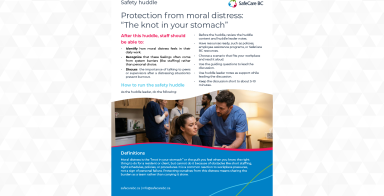
This huddle will help you lead a discussion on moral distress and the importance of talking to peers or supervisors after a distressing situation to prevent burnout.
Files Attached
View Safety huddle
This safety huddle can be used to lead a discussion on how assuming positive intent can reduce workplace tension.
Files Attached
View Safety huddle
Mastering work-life balance is essential for healthcare safety. Discover practical strategies to prevent burnout, manage busy shifts, and improve care for those you support.
Files Attached
View Safety huddle
Learn when workers can stop unsafe tasks, report concerns, and follow the right process to stay safe.
Files Attached
View Safety huddle
Equip your team with the skills to spot workplace hazards before they cause an injury. This safety huddle guides staff through conducting an environmental scan, a key part of any point of care risk assessment. Discover how to build a proactive safety culture and protect your healthcare team.
Files Attached
View Safety huddle
In this huddle, we’ll review safe and effective cleaning and disinfecting practices in the workplace. Staff will learn how to follow workplace policies, clean and disinfect shared equipment and high-touch areas, and select the right personal protective equipment (PPE) for different cleaning tasks. We’ll also cover where to find important information such as safety data sheets and product labels, which explain safe handling and spill response procedures. Use the guiding questions to spark discussion about common high-risk areas, frequently shared items, and strategies for reducing the spread of infectious diseases.
Files Attached
View Safety huddle
Working with clients or residents and their families is not always easy. You may not be able to control how others act, but you can control how you respond.
Files Attached
View Safety huddle
When a critical incident impacts your team, it's vital to have a safe space to talk and heal. Our critical incident debriefing tools provide leaders and frontline staff in BC's long-term care and home support sectors with a structured way to discuss what happened, ensuring everyone feels supported with dignity and respect. Discover how to create a culture of psychological safety, identify available resources, and learn to navigate these challenging conversations to promote recovery and well-being.
Files Attached
View Safety huddle
Browse by Resource Type

Resources Related to 

This fall, the Hearts and Hands conference for health care assistants will bring frontline care workers together for a day of learning, connection and celebration. In Langley, Jody Braam will lead a breakout session exploring what it means to truly listen in dementia care, even when words are no longer there.   Jody Braam was […]
View News Story
There’s a strange thing that happens when you become very good at holding everything together. People stop asking if you are okay.  You show up, do the work, care for the people who need you and become the person others can rely on. Somewhere along the way, carrying too much can start to look a […]
View News Story
Webinar slides for Carmen Smith's presentation, The weight of grief: Understanding and moving forward.
Files Attached
View Presentation
SafeCare BC Logo
©2026 SafeCare BC | All rights reserved.
To empower workplaces that provide care to create a culture of safety through evidence-based education, advocacy for safer workplaces, leadership, and collaboration
cross