SafeCare BC Logo
SafeCare BC Logo
Programs & Services

Programs and Services

View All
We are dedicated to providing comprehensive occupational health and safety (OHS) consulting services tailored to your needs.
View Service

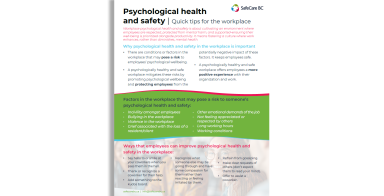
Psychological health and safety, often called workplace mental health, encompasses principles and practices to foster a supportive, respectful, and psychologically safe work environment.
View Service

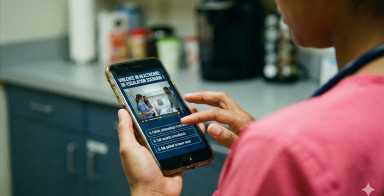
The Provincial Violence Prevention Curriculum is recognized as best-practice in violence prevention training for health care workers.
View Service
Workplace communication improves when teams use strength-based language, I statements, objective words, and curiosity to build trust.
Words matter | Infosheet

Small shifts for a safer, stronger team

Why words matter

Every day, the words you choose act like seeds in a garden. Choose a “flower”—a respectful, clear word— and you build trust. Choose a “weed”—a judgment or a label—and you create a space where it is hard for a healthy team to grow. Communication is a skill that everyone can practice and improve.

Four tools for better conversations

  1. Use strength-based language
    Focus on what is going well and the effort being made, rather than only pointing out what is missing.
    • Instead of: “Why is Mrs. Smith still in her room? She should be ready for breakfast.”
    • Try saying: “You’ve done a wonderful job getting so many residents ready. I really appreciate how organized you are on such a busy morning.”
  2. Be objective and descriptive
    Describe exactly what you see without labelling a person or assuming their motives.
    • Instead of: “He’s so lazy and never does his work.”
    • Try saying: “I notice that when phones are out during team meetings, some people’s attention seems to be elsewhere.”
  3. Practice “I” statements
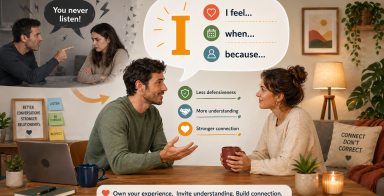
    Focus on your own experience to take the blame out of the conversation. This helps others listen without becoming defensive. The Structure: “I feel… when… because…”
    • Instead of: “You can never be on time. You’re being inconsiderate.”
    • Try saying: “I feel frustrated when we can’t start on time. It makes it harder for me to stay organized and support the team.”
  4. Validate their experience
    Acknowledge that someone else’s feelings are real to them, even if you see the situation differently.
    • Instead of: “You’re overreacting. It’s not a big deal.”
    • Try saying: “I can understand why that feels frustrating, especially with everything else on your plate.”

                Talking ABOUT people

                How we talk about colleagues when they are not in the room shapes our team culture.

                • Choose curiosity over judgment: If a colleague leaves exactly at the end of their shift, don’t assume they don’t care.
                • Ask “What else might be true?”: They might have a second job, a child to pick up, or an elderly parent to care for.
                • Generous language: When we talk about people generously, we create a space for generosity to come back to us.

                Quick daily checklist

                • Did I catch one judgment today and replace it with a question?
                • Did I notice something a teammate did well and tell them?
                • If I felt frustrated, did I use an “I” statement instead of a “You” statement?
                • Am I speaking to people’s strengths?
                Downloads
                Words matter | Infosheet
                Download
                1023.1KB

                More Info Sheets

                Workplace communication improves when teams use strength-based language, I statements, objective words, and curiosity to build trust.
                Files Attached
                View Info Sheet
                A joint occupational health and safety (JOHS) committee is an advisory group of employer and employee representatives working together to promote a safe and healthy workplace.
                Files Attached
                View Info Sheet
                Workplace psychological health and safety is about cultivating an environment where employees are respected, protected from mental harm, and supported–ensuring their well-being is prioritized alongside productivity. It means fostering a culture where work enhances, rather than diminishes, mental health.
                Files Attached
                View Info Sheet
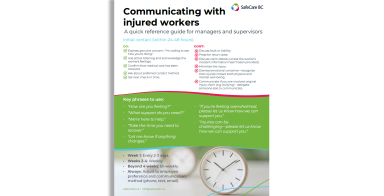
                A quick reference guide for managers and supervisors with information on communicating with employees who are injured.
                Files Attached
                View Info Sheet
                “I” statements help shift difficult conversations from blame to connection. By focusing on your own feelings, the situation, and its impact, you can reduce defensiveness, improve understanding, and build healthier communication habits at work and at home.
                Files Attached
                View Info Sheet
                Provided by Road Safety At Work, this document informs Home Care and Community Care workers with ways to stay safe while driving in the winter.
                Files Attached
                View Info Sheet
                Browse by Resource Type

                Resources Related to , ,

                “I” statements help shift difficult conversations from blame to connection. By focusing on your own feelings, the situation, and its impact, you can reduce defensiveness, improve understanding, and build healthier communication habits at work and at home.
                Files Attached
                View Info Sheet
                Strong communication is essential for a safe and respectful healthcare workplace. Learn how using “I” statements can reduce conflict, build trust, and support better teamwork during high-stress situations.
                Files Attached
                View Safety huddle
                Communication is a skill that everyone can practice and improve. This info sheet offers four practical tool you can use to help build health workplace relationships.
                Files Attached
                View Infosheet
                Use this info sheet to learn how “I” statements can be used to shift your workplace communication from blame to connection.
                Files Attached
                View Infosheet
                SafeCare BC Logo
                ©2026 SafeCare BC | All rights reserved.
                To empower workplaces that provide care to create a culture of safety through evidence-based education, advocacy for safer workplaces, leadership, and collaboration
                cross