SafeCare BC Logo
SafeCare BC Logo
Resources & Tools

Resources and Tools

View All

Resources and services to support your well-being and psychological safety at work.
View Safety Topic

In long-term care it is increasingly apparent that who is on shift is just as important as how many staff are on shift. Quality care is difficult to achieve when we do not routinely engage with one another in a positive, or civil, manner.
View Toolkit
Programs & Services

Programs and Services

View All
We are dedicated to providing comprehensive occupational health and safety (OHS) consulting services tailored to your needs.
View Service

Psychological health and safety, often called workplace mental health, encompasses principles and practices to foster a supportive, respectful, and psychologically safe work environment.
View Service

The Provincial Violence Prevention Curriculum is recognized as best-practice in violence prevention training for health care workers.
View Service
Guidelines & Regulations

Guidelines and Regulations

View All
WorkSafeBC is holding a second public hearing this month on proposed changes to the Occupational Health and Safety Regulation related to combustible dusts.
View News Story
Amendments to the Occupational Health and Safety Regulation (OHSR), Part 5: Chemical Agents and Biological Agents – Emergency Planning came into effect on February 3, 2025. Changes include additional requirements to minimize the risk, likelihood, and harm caused by an emergency involving hazardous substances.   Hazardous substances include biological, chemical or physical hazards that may reasonably […]
View News Story
Checklist

Injured at Work - Employer Checklist

This sample employer checklist outlines an employer’s immediate and follow-up responsibilities.

External Resources
This resource is not hosted by SafeCare BC. The button below link will take you to an external website.
View Resource
Injured at Work - Employer Checklist

Additional Resources

When injuries at work happen, it is important to report the incident.
View Safety Topic

More Checklists

Motor vehicle incidents are among the leading causes of traumatic workplace injuries and fatalities in BC. The Safe Driving for Work Checklist has been developed to help employers and their workers take proactive steps to manage driving-related risks. This checklist serves as a practical guide to reinforce safe driving practices and is designed to be used before, during, and after each trip.
Files Attached
View Checklist
Workplace inspections are an essential incident prevention tool in an organization's occupational health and safety program. Use this checklist to help identify and record hazards for corrective action.
Files Attached
View Checklist
This orientation checklist helps ensure temporarily displaced workers receive the health and safety information they need to be well-equipped to handle their temporary working environment.
Files Attached
View Checklist
You can use the Safe Handling Program Checklist to verify the components of a safe handling program, including development, management and staff involvement, needs assessments, equipment, education and training, and evaluation.
Files Attached
View Checklist
This guide is intended to make employers aware of the parts of the Occupational Health and Safety Regulation that prevention officers will be focusing on as part of the Health Care Planned Inspectional Initiative.
View Checklist
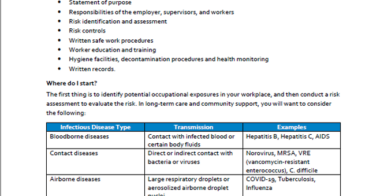
Use this checklist to help you create an exposure control plan for infectious diseases.
Files Attached
View Checklist
This sample employer checklist outlines an employer’s immediate and follow-up responsibilities.
View Checklist
Browse by Resource Type

Resources Related to 

This rubric contains a list of typical limitations for common physical injuries.
View Web link
When injuries at work happen, it is important to report the incident.
View Safety Topic
SafeCare BC Logo
©2025 SafeCare BC | All rights reserved.
We strive to empower those working in the continuing care sector to create safer, healthier workplaces by fostering a culture of safety through evidence-based education, leadership, and collaboration.
cross