SafeCare BC Logo
SafeCare BC Logo
Programs & Services

Programs and Services

View All
We are dedicated to providing comprehensive occupational health and safety (OHS) consulting services tailored to your needs.
View Service

Psychological health and safety, often called workplace mental health, encompasses principles and practices to foster a supportive, respectful, and psychologically safe work environment.
View Service

The Provincial Violence Prevention Curriculum is recognized as best-practice in violence prevention training for health care workers.
View Service
Guidelines & Regulations

Guidelines and Regulations

View All
Changes to WorkSafeBC’s Occupational Health and Safety Regulation take effect on January 4, 2027. The amendments clarify what combustible dust is and strengthen requirements for identifying, assessing, and controlling fire and explosion risks.  What does this mean for you?  Using flour or sugar in a kitchen does not automatically mean a new combustible dust management […]
View News Story
WorkSafeBC has paused its consultations on proposed changes to the Occupational Health and Safety Regulation addressing psychological health and safety, harassment, and violence. The pause is due to the provincial election and is procedural; it does not indicate that a decision has been made about the proposed changes.  The proposals would introduce significant new and […]
View News Story


Safety huddle

Recognizing and managing psychological demands in healthcare 

Use this safety huddle to lead a conversation about the psychological demands in healthcare.
Recognizing and managing psychological demands in healthcare 

After this huddle, staff should be able to:

  • Identify common psychological demands present in your specific role. 
  • Describe how emotional demands like grief or responsive behaviours can impact your well-being. 
  • Apply one team-based strategy to better support colleagues facing high emotional demands. 

How to run the safety huddle

As the huddle leader, do the following: 

  • Before the huddle, review the huddle content and huddle leader notes. 
  • Have resources ready, such as policies, employee assistance programs, or SafeCare BC resources. 
  • Choose a scenario (or topic) that fits your workplace and read it aloud. 
  • Use the guiding questions to lead the discussion. 
  • Use huddle leader notes as support while leading the discussion. 
  • Keep the discussion short to about 5-10 minutes. 

Definition

Psychological demands are the emotional and social parts of your job. In healthcare, this includes things like dealing with illness and grief, managing difficult behaviours, or navigating complex relationships with families. When these demands are higher than the support available, it can impact your mental health and well-being. 

Scenario for long-term care

Amara is a care aide at Willow Creek Home who has cared for Mr. Henderson for over two years. Mr. Henderson’s health is declining rapidly, and he is now receiving end-of-life care. Amara spends much of her shift sitting with him, navigating his physical pain and the quiet sadness of the room. During her shift, Mr. Henderson’s daughter arrives, visibly distraught, and begins questioning Amara about why her father isn't "getting better" today. Amara feels a heavy weight in her chest, trying to balance her own sadness about Mr. Henderson’s decline while trying to provide emotional comfort to his daughter. As she leaves the room to start her next task, she feels emotionally exhausted and unsure how to reset for her next resident. 

Guiding questions for long-term care 

  • What specific psychological demands is Amara facing in this moment? 
  • How might caring through loss affect Amara’s ability to finish her shift safely?  
  • How could Amara ask for support from her team right after this interaction? 

Facilitation tips: Acknowledge that exposure to death and dying is one of the toughest parts of the job. If the group focuses only on the work of end-of-life care, redirect them to the emotional toll it takes on the person providing that care. 

Downloads
Recognizing and managing psychological demands in healthcare 

More Safety huddles

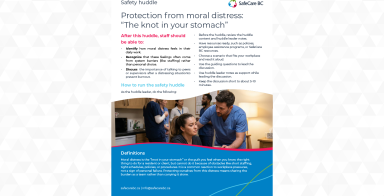
This huddle will help you lead a discussion on moral distress and the importance of talking to peers or supervisors after a distressing situation to prevent burnout.
Files Attached
View Safety huddle
This safety huddle can be used to lead a discussion on how assuming positive intent can reduce workplace tension.
Files Attached
View Safety huddle
Mastering work-life balance is essential for healthcare safety. Discover practical strategies to prevent burnout, manage busy shifts, and improve care for those you support.
Files Attached
View Safety huddle
Learn when workers can stop unsafe tasks, report concerns, and follow the right process to stay safe.
Files Attached
View Safety huddle
Equip your team with the skills to spot workplace hazards before they cause an injury. This safety huddle guides staff through conducting an environmental scan, a key part of any point of care risk assessment. Discover how to build a proactive safety culture and protect your healthcare team.
Files Attached
View Safety huddle
In this huddle, we’ll review safe and effective cleaning and disinfecting practices in the workplace. Staff will learn how to follow workplace policies, clean and disinfect shared equipment and high-touch areas, and select the right personal protective equipment (PPE) for different cleaning tasks. We’ll also cover where to find important information such as safety data sheets and product labels, which explain safe handling and spill response procedures. Use the guiding questions to spark discussion about common high-risk areas, frequently shared items, and strategies for reducing the spread of infectious diseases.
Files Attached
View Safety huddle
Working with clients or residents and their families is not always easy. You may not be able to control how others act, but you can control how you respond.
Files Attached
View Safety huddle
Providing compassionate end-of-life care is a profound part of the job, but it can also lead to grief and loss for frontline staff. This can impact well-being and team morale. Fostering a workplace culture where open conversations about grief are supported is crucial for the health and safety of your team. Discover how to recognize grief in the workplace and provide essential support to your healthcare staff.
Files Attached
View Safety huddle
Browse by Resource Type

Resources Related to ,

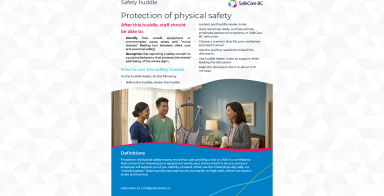
Use this Safety Huddle to start a conversation about the connection between physical and psychological safety, and how teams can support one another in speaking up about unsafe working conditions.
Files Attached
View Safety huddle
This week's Health and Safety Matters issue explores what workplace loneliness can look like and practical ways teams can strengthen connection. Also in this issue: Register for an upcoming webinar that will give you the tools to foster respectful communication. Learn about some of the benefits of being a SafeCare BC member.
Files Attached
View Newsletter Issue
Discover how teams can adopt a strengths-based approach that sparks awe and wonder, fostering greater belonging and mattering.
View Webinar
“I was sent here.”  It’s an admission Steve Rookyard sometimes hears at the beginning of a training day. The person has shown up, but their interest has yet to follow.  For him, that’s somewhere to start.   What would make the day useful to them?   What questions do they have?   What happens at work that the […]
View News Story
SafeCare BC Logo
©2026 SafeCare BC | All rights reserved.
To empower workplaces that provide care to create a culture of safety through evidence-based education, advocacy for safer workplaces, leadership, and collaboration
cross