SafeCare BC Logo
SafeCare BC Logo
Resources & Tools

Resources and Tools

View All
Resources and services to support your well-being and psychological safety at work.
View Safety Topic
In long-term care it is increasingly apparent that who is on shift is just as important as how many staff are on shift. Quality care is difficult to achieve when we do not routinely engage with one another in a positive, or civil, manner.
View Toolkit
Programs & Services

Programs and Services

View All
We are dedicated to providing comprehensive occupational health and safety (OHS) consulting services tailored to your needs.
View Service
Psychological health and safety, often called workplace mental health, encompasses principles and practices to foster a supportive, respectful, and psychologically safe work environment.
View Service
The Provincial Violence Prevention Curriculum is recognized as best-practice in violence prevention training for health care workers.
View Service
Guidelines & Regulations

Guidelines and Regulations

View All
WorkSafeBC is holding a second public hearing this month on proposed changes to the Occupational Health and Safety Regulation related to combustible dusts.
View News Story
Amendments to the Occupational Health and Safety Regulation (OHSR), Part 5: Chemical Agents and Biological Agents – Emergency Planning came into effect on February 3, 2025. Changes include additional requirements to minimize the risk, likelihood, and harm caused by an emergency involving hazardous substances.   Hazardous substances include biological, chemical or physical hazards that may reasonably […]
View News Story
Safety Month - December 2025

Safety Program

Whether you review your program all at once or break it down month by month, all elements of your health and safety program must be reviewed at least once a year.

A comprehensive health and safety program is the foundation for a safe and healthy workplace. It protects the safety of employees and minimizes risks. As we approach the end of the year, it’s crucial to start thinking about the requirement to annually review all health and safety programs.

You can review your program all at once or break it into manageable sections throughout the year, but every element must be examined at least annually. Remember to involve workers in the review process, as their input is essential to creating an effective program.

Why review your health and safety program?

Regular reviews ensure your program remains effective, up-to-date, and aligned with current workplace needs.

  • Ensure effectiveness: Reviewing your program helps confirm that policies, procedures, and controls are still working as intended.
  • Compliance: Regular reviews help you maintain compliance with occupational health and safety regulations.  
  • Identify improvements: Your findings help organizations identify gaps, update procedures, and strengthen overall workplace health and safety.

What makes an effective health and safety program?

Health and safety programs vary depending on the workplace. Factors such as your organization’s size, hazard rating, and specific safety requirements influence what your program looks like.

An effective program will:

  • Identify and control workplace hazards
  • Prevent workplace incidents
  • Reduce injury rates
  • Lower the financial costs associated with workplace injuries and diseases
  • Build a strong culture of safety
  • Meet regulatory requirements, including Section 3.3 of WorkSafeBC’s Occupational Health and Safety Regulation (OHSR)

Core elements of a health and safety program

While programs differ across workplaces, most include the following foundational components:

  • Occupational Health and Safety policy
  • Hazard identification, risk assessment, and control measures
  • Regular inspections of premises, equipment, work methods, and work practices
  • Joint Occupational Health and Safety (JOHS) Committee
  • Safe Work Procedures and other written instructions for workers
  • Instruction, supervision, and training, including orientation and ongoing education
  • Regular safety meetings
  • Personal Protective Equipment (PPE)
  • First aid
  • Emergency preparedness
  • Incident reporting and investigation
  • Record-keeping, including health and safety documentation and statistics

We have resources to support your health and safety program, from our Injury Management Program Manual, Webinars for leaders,  safety huddles, sector-specific training and education and our Tailored Outreach Program (TOP).

First time evaluating your health and safety program? WorkSafeBC has an Annual Review Evaluation Tool to get you started. 

Can’t find what you’re looking for? Reach out to our team at info@safecarebc.ca 

Have questions about this month's topic? Ask us!

12 Months Contact Form
Safety Program

Featured Resources

Starting at $71.98
Let’s make safety second nature. Learn how to protect yourself and others—begin the course now.
View Elearning
SafeCare BC’s Tailored Outreach Program—TOP for short—launched in 2018 and is designed to increase an organization’s awareness of its health and safety program.
View Service
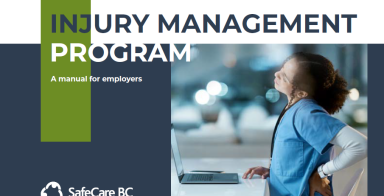
Whether you are developing or re-evaluating your injury management program, this guide for developing and implementing an injury management program (also referred to as a recover-at-work or return-to-work program) for workers who have experienced a work-related physical or psychological injury, illness, or occupational disease.
Files Attached
View Toolkit
We are dedicated to providing comprehensive occupational health and safety (OHS) consulting services tailored to your needs.
View Service
Filter

Safety Program resources

Resource Types

Resource Post Type Filter
  • Posts (297)

Audiences

Post

Northbridge Insurance sponsors Safety Den

We are pleased to announce that Northbridge Insurance is partnering with us to support our tenth annual Safety Den event, which is being held on May 25, 2026, at the BC Care Providers annual conference,...

Post

Recapping Hearts and Hands 2025

With three locations and over 550 passionate attendees, this year’s Hearts and Hands conference was more than an event—it was a movement. Let's take a look back at the 10th anniversary!

Post

The love story no one saw coming

Engagement, Mental Health, Organizational culture, Other, Psychological social support, Recognition and reward, Self-care

This story is told from the perspective of Billie Askelend, Senior Executive Director at Nicola Lodge.  No one expected a love story to begin at Nicola Lodge, least of all Roy. At eighty-nine, he had...

Post

Stitching with love at Elim Village

Organizational culture, Person-centered care

My name is Carol, and I have been crocheting for more than 50 years. I first picked it up when I was pregnant with my youngest daughter because I wanted to quit smoking and needed...

SafeCare BC Logo
©2025 SafeCare BC | All rights reserved.
We strive to empower those working in the continuing care sector to create safer, healthier workplaces by fostering a culture of safety through evidence-based education, leadership, and collaboration.
cross